Tag Archives: National Day for Truth and Reconciliation

Full Circle

“It may seem like it is someone else’s children (being killed) – but there is no such thing as someone else’s children.”  Omar El Akkad, One Day Everyone Will Have Always Been Against This

When I opened the surprise parcel, out tumbled a beautiful green and white keffiyeh* – a gift from my friend Emily, along with a letter sharing the story of why she was giving it to me.

Briefly, the story goes like this. Emily’s daughter and son-in-law were producers on a film you may have heard of – Sugar Cane – the award-winning documentary which investigates St. Joseph’s Mission in Williams Lake First Nation directed by Julian Brave NoiseCat and Emily Kassie.

When in Los Angeles for the launch of Sugar Cane, her son-in-law fell into conversation with a director from Palestine. I can only imagine them sharing the different versions of settler colonialism, occupation, and genocide practiced  in North America and in Palestine. The Palestinian film director gifted Emily’s son-in-law with the green and white keffiyeh. In time, he offered it to Emily’s husband John.

After a while, they felt the keffiyeh should move on and they gifted it to me. The keffiyeh arrived at the perfect time – I was feeling despair and helplessness as the ongoing genocide in Gaza and violence in the West Bank continued to worsen, and the world watched in silence. 

Emily sent information about Sugar Cane, which was about to be released. It showed at the Broadway Theatre in Saskatoon but I was unable to go. I knew it was streaming, and while I read reviews and listened to interviews, I never managed to see the film that first year.

Guess what came to my own community on September 30, 2025 (our National Day for Truth and Reconciliation)? You’ve got it – Sugarcane was showing at the gym at Wapiimoostoosis – the only remaining part of the residential school which operated in Lebret for over 115 years.  Members of Star Blanket Cree Nation and the surrounding communities gather each September 30th for a pipe ceremony, a smudge walk, to share stories from survivors and to enjoy a delicious lunch together.

Artist Chasity Starr, her “healing”  mural and her proud family looking on, back of gym at Wapiimoostoosis

Three generations – Chasity and her mural, her mum and her nephew, back of Gym at Wapiimoostoosis

This seemed exactly the right place and the right time to see Sugarcane. With a bag of warm popcorn, I watched Sugarcane on the big screen with my friends, my treaty relatives, and my neighbours.

Just two weeks previous, I was on Parliament Hill attending part of five day vigil called the March to Ottawa. The March to Ottawa honoured the 20,000+ children who have been murdered in Gaza by inviting people to read aloud their names over the course of the 5 days. The first reader was Anishinaabe elder Albert Dumont, former poet laureate of Ottawa, and member of the Kitigan Zibi Anishinabeg First Nation. His words, and the empty shoes, roller skates, sandals and boots that symbolized some of those lost lives reminded me of the shoe memorials  found          across Canada after 215 potential graves of children were discovered at Kamloops in 2021. In both cases, the shoes symbolize children’s lives tragically cut short through acts of genocide by the occupying power.

As well as reading the names of children over the five days, hundreds of Ottawan’s contributed a banner which stretched a city block where the name of murdered children were written in hand. Dozens held this banner aloft and in silence on the day I attended the March to Ottawa.

Opening Remarks, March to Ottawa, September 15, 2025

Shoes to honour the children who attended residential school across Canada and who never came home. Credit: Okotoks Online

Omar El Akkad’s words (quoted at the top) have been echoing in my heart this fall. In the dedication to his book, he quotes Polish poet and essayist Wislawa Sxymborska from her poem “Vietnam”. It’s worth sharing here:

“Woman, what’s your name?” “I don’t know.”
“How old are you? Where are you from?” “I don’t know.”
Why did you dig that burrow?” “I don’t know.”
“How long have you been hiding?” “I don’t know.”
“Why did you bite my finger?” “I don’t know.”
“Don’t you know that we won’t hurt you?” “I don’t know.”
“Whose side are you on?” “I don’t know.”
“This is war, you’ve got to choose.” “I don’t know.”
“Does your village still exist?” “I don’t know.”
“Are those your children?” “Yes.”
Polish; trans. Stanislaw Barnczak & Clare Cavanagh

“Are those your children? Yes.” Five words.

I highly recommend watching Sugarcane .  One reviewer writes,”  It’s a remarkably courageous and exposed work, particularly for co-director Julian Brave NoiseCat and his father, Ed Archie NoiseCat, whose painful journey together in search of healing is the film’s spine.” I was moved by the measured telling of this story. Incredible real-life investigator Charlene Belleau has imprinted her solid  determination, courage, and love on me for always. Her  steadfast commitment to finding out the truth about these children, and honouring them by doing so remind us indelibly that all of the children, every one,  are in our care.


*Keffiyehs were first used as a symbol of resistance, self-determination, justice and freedom during the Arab Revolt against British Colonial Rule during the 1930s. Often they are black and white. I love that mine is green and white symbolizing resurgence. I wear it in solidarity. For me, It says, “the Palestinian people can never be erased.’ The center fishnet pattern represents Palestinian fishers and the people’s close connection to the Mediterranean. The olive tree pattern represents perseverance, strength and resilience. The lines along the edges represent trade routes with neighbours.

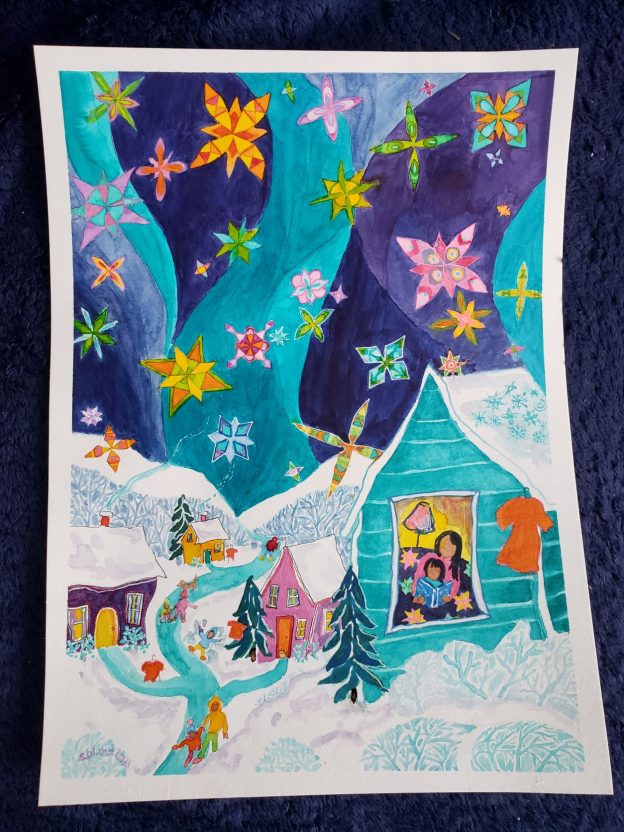
Every Child

I often think about children in December. A lifetime ago, I worked at our community school. I remember the fraught, exciting, and sometimes magical time leading up to Christmas  as we tried to make the best possible memories for our kids. Being a parent is frequently overwhelming, and in the period before Christmas, the Overwhelm Factor looms LARGE. I recall the struggle of many parents, myself included, who could not afford many gifts, and the societal pressure to give more. And more.

Working every day with children, I sensed an acute longing that ran deep beneath seasonal shifts. What every child most needed was the truly attentive presence of at least one adult. “Don’t worry so much about all the gifts,” I wanted to say. “Spend time with your kids. Ordinary time, and special times, too.” Of course, often the advice we give, is the advice we ourselves need.  As a parent myself, I knew how hard  being truly present to my children could be. Some days,  I could hardly be present to myself! But there were moments…perhaps on a walk, or cuddled together reading a book. Baking together. Learning to skate together.  Stopping to watch a snowy owl on the way home. If December is about children, in our rush to “get it all done”, we often overlook the gift of simple (and not so simple) presence and attention that every child needs and longs for.

September 30, 2021

Continuing to think about children, I travel back in my mind to September 30th, 2021 – the first ever National Day for Truth and Reconciliation in Canada. A day set aside for survivors and intergenerational survivors of Indian Residential  Schools to ask Canadians  “to see us, to hear us and to believe us,” after unmarked graves were unearthed and confirmed at former residential schools across the land. As this day approaches, my husband and I are spending a few days along the shores of Lake Superior. I feel a heaviness welling up inside me as September 30th approaches. How will I mark this day? I  intended to be at home, joining a walk from the present Okanese School to the site of the former United Church run residential school, both on the same reserve. As we drive, we  listen to the stories of  survivors on the radio. I  think about the  people I know – family, friends, neighbours of all ages- who have been deeply affected by the legacy of these “schools”.

That evening, I collect random pebbles as I walk the beach.  Each is so beautiful and unique. Long smoothed by the motion of water over sand, they come in beautiful colours –  dusty rose, slate gray, white, ochre. I get an idea. I drop to my knees and smooth out a circle on the beach with the palm of my hand. Smoothing sand is soothing. Listening to the rhythmic sound of the waves rolling in calms me. I remember many contented moments as a child, doing just this, smoothing sand and arranging pebbles. Absorbed.

I collect more pebbles. I choose slate gray pebbles to spell  the word “EVERY” in capitals in the circle. Slate gray gives emphasis to this word. No child is left out.

For the word “child” , I use all the colours of pebbles spelled in lower case letters. Somehow, lower case letters seem vulnerable, like children are vulnerable. With each pebble I place, I think of a child I have known or who I know now. Some are thriving, others are getting along. Too many died way before their time from violence or suicide, drugs or a car accident.  A legacy not only of residential schools, but also our colonial and genocidal actions, past and present. I notice how the sand quickly covers some pebbles, rendering them almost invisible. I clean the sand off each pebble, so that each can be seen, can takes its proud place in forming this word.

The verb “MATTERS“, I spell out in capital letters in dusty rose – the colour of the heart. I think of the many ways we invisibilize children, especially those children who are not “easy”. I remember the times I have dismissed a child’s feelings. I consider how the unmarked graves are material (matter) evidence for something Indigenous people have always known.

Around the edge of the circle, I poke clusters of pine needles into the sand. The pine needles provide a border, some protection maybe, but what is inside the circle is now open to the air. All wounds need air in order to begin the process of healing. I find two wrapped orange lollipops which are from a feast I attended in honour of children who never made it home. These go on either side of the word “child” signifying the pleasures of childhood these lost children  missed.  Spelling these words, smoothing the sand, and thinking about so many friends and relatives allows the heaviness in me to shift a little. Creating this beach art feels exactly like a prayer.

Every Child Matters – Lake Superior, Sept. 30, 2021

The Orange Shirt at the End of Our Lane – Every Child Matters

When we returned home, our daughters welcomed us with an orange shirt at the end of our lane. The orange shirt remains there. Each time I see it, I feel a slight jolt inside.  It has blown in the wind, fallen on the ground and been hung again. Each day it changes. I don’t want to get used to the orange shirt. I don’t want to forget.

The orange shirt reminds me….

EVERY      child     MATTERS                                                                                                                                                    Every child matters. See us, hear us, believe us. Truth before reconciliation.

Listen. Learn what I can. Unlearn what I grew up knowing. Learn about past injustices but learn also about present injustices. Learn from the brilliance and wisdom of Indigenous people. Listen.

I can offer my support in practical  and respectful ways as our neighbours and friends begin a ground search for lost children at the former Lebret Indian Residential School. Volunteers, food, money are needed.  I can also offer my prayers.

Back when I worked in the community school, we had pins that said  “It takes a village to raise a child.” So many wonderful people and creatures helped us raise our children. Can I be part of that village? Can I give back? Can I help lighten the load for other parents and grandparents?  I can try.

Every day the orange shirt reminds me that I need to live as if “every child matters”.              Every day, the orange shirt challenges me.

I am alert for the openings that help me truly live as if every child matters.

Every child matters … every day.

Orange Shirt Design by L. Delorme